Why Stylish Web Design is the New Black
Why Stylish Web Design Is No Longer Optional in 2026
Stylish web design is one of the most powerful tools a business has to make a strong first impression online. And in 2026, the bar has never been higher.
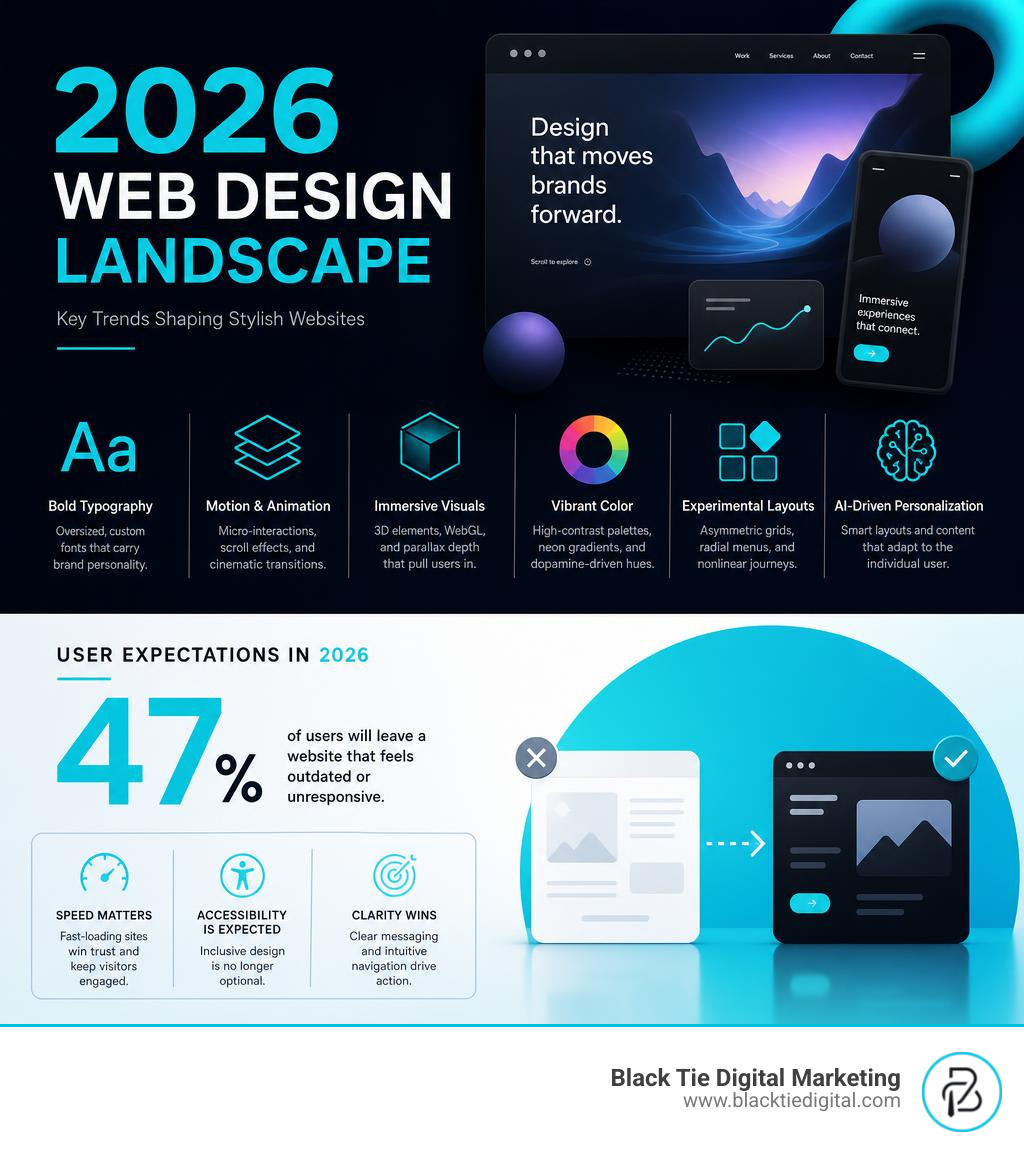
Here is a quick look at what defines a stylish website today:
- Bold Typography: Oversized, custom fonts that carry brand personality
- Motion and Animation: Scroll effects, micro interactions, and cinematic transitions
- Immersive Visuals: 3D elements, WebGL, and parallax depth
- Vibrant Color: High contrast palettes, neon gradients, and dopamine driven hues
- Experimental Layouts: Asymmetric grids, radial menus, and nonlinear user journeys
- AI Driven Personalization: Layouts and content that adapt to the individual user
These are not optional extras. They are what separates a forgettable website from one that builds real trust and keeps visitors engaged.
The digital landscape has shifted fast. Features like dark mode and parallax scrolling were once cutting edge. Today they are baseline expectations. Nearly half of all users (47%) will leave a site that feels outdated or unresponsive. That means your design is either working for your brand or quietly working against it.
And it is not just about looks. The best stylish websites balance bold aesthetics with speed, accessibility, and clear messaging. Getting that balance right is where most brands struggle.
I am Scott Brazdo MBA, CEO of Black Tie Digital Marketing, and over 20 years I have led the rebranding of more than 500 companies, helping each one use stylish web design as a strategic growth tool rather than just a visual upgrade. In the sections ahead, I will break down exactly what makes a website feel premium in 2026 and how your brand can get there.
What Defines Stylish Web Design in 2026
In the past, a stylish website often meant a highly polished, static page with clean lines and plenty of white space. Today, the definition has expanded. A stylish layout in 2026 is an active, immersive experience that tells a story. It is a visual identity that feels alive, adapting to user movements and offering tactile feedback.
To create this premium feel, designers utilize sophisticated tools like Figma and the Adobe Creative Suite. They gather inspiration from leading showcases such as Siteinspire and Awwwards, where the absolute best digital art direction is celebrated. These platforms highlight how top creators use asymmetry, custom typography, and organic motion to capture attention.
When we build a premium website, we focus on several key pillars to ensure high user engagement and strong user retention. If you want to dive deeper into these foundational rules, you can read our guide on Website Design Tips which covers strategies that consistently deliver results.

To make a website feel truly premium, we look to successful design systems like the Atelier Luxe Craftsman template. This design demonstrates how restraint and precision can create a sense of luxury. It uses deep colors, beautiful serif typography, and elegant scroll effects to communicate craftsmanship.
Here are the essential elements that define a premium design in 2026:
- Deliberate Restraint: Avoiding the temptation to clutter the page with too many elements at once.
- Custom Typography: Using unique, highly legible font pairings that reflect the brand voice.
- Tactile Interactions: Buttons and menus that respond to hovers with smooth, organic transitions.
- Consistent Color Systems: Utilizing limited, purposeful color palettes that guide the eye to key actions.
- Sought After Scarcity: Creating clean layouts that give each piece of content room to breathe.
By focusing on these elements, a website ceases to be just a digital brochure. It becomes an active extension of your brand that users want to explore.
Key Trends Shaping Modern Digital Aesthetics
Immersive 3D Elements and Motion
The rise of WebGL and advanced browser capabilities has made three dimensional visuals a massive trend. Instead of flat images, modern websites use interactive 3D models that users can rotate or manipulate. This is highly effective for product showcases, allowing visitors to view items from every angle.
Motion design is no longer just about making things move. It is about creating a cohesive narrative. Scroll animations, smooth parallax scrolling, and micro interactions make the act of reading a web page feel like a cinematic journey.

A fantastic example of this in action is the Building 4WIDE experience, which shows how designers can turn distortion, blur, and motion into a beautifully unified user journey. By syncing text movement with curved image flows, the site creates a deep sense of immersion without sacrificing performance.
Bold Typography as a Core Element of Stylish Web Design
Typography has transitioned from a supportive element to the main hero of the page. Designers are now using massive, custom display fonts as primary graphic elements. Kinetic lettering, variable fonts that change weight on scroll, and layered text over rich imagery are all used to establish a powerful visual hierarchy.
This approach is highly effective because it immediately communicates brand personality. However, relying on standard templates can limit your typographic freedom. This is why we often say that Templates as frenemies can hold your brand back. While templates offer speed, they rarely support the bold, customized typographic layouts needed to stand out in a crowded market.
Experimental Navigation and Layouts
Standard top navigation bars with predictable dropdown menus are being replaced by experimental navigation systems. Radial menus, hidden drawers, interactive maps, and horizontal scrolling galleries are becoming highly popular. These unconventional layouts encourage exploration, turning a standard visit into an adventure.
For a look at how these interactive features are built, developers and designers often study the Creative Agency Style repository. This project showcases how to implement a custom magnetic cursor, smooth horizontal scrolling, and advanced parallax animations to create a highly memorable digital experience.
AI Driven Personalization and Generative Layouts
Artificial intelligence is changing how we think about the web design process. Rather than replacing human creativity, AI is acting as a powerful assistant. In fact, 72% of designers now use generative AI in their workflows, and an incredible 91% of designers state that AI improves the quality of their outputs, not just the speed. This technological shift is also boosting morale, as designers who increase their AI usage are 25% more likely to report growing job satisfaction.
AI allows for generative design, where layouts and content can adapt in real time to match user preferences. This level of personalization ensures that every visitor gets a tailored experience. To combat generic layouts that some AI tools generate, systems like the Hallmark design skill have emerged. This system enforces strict design rules, such as distinct font pairings and asymmetric layouts, to ensure that AI generated pages look completely unique, human, and premium.
Balancing Bold Aesthetics with Usability and Performance
Maintaining Accessibility in Stylish Web Design
While experimenting with bold colors and complex layouts is exciting, we must never forget usability. An accessible website is a legal and ethical requirement. If your site is difficult to navigate for users with disabilities, you risk losing a massive portion of your audience.
To balance high aesthetics with accessibility, designers must focus on high contrast color ratios, clear keyboard navigation, and screen reader compatibility. The Xora SaaS landing page is an excellent example of a modern, highly stylized landing page that maintains clean code and responsive structures, ensuring that advanced visual effects do not break the user experience for assistive technologies.
Here is how we balance creative aesthetic choices with critical accessibility solutions:
- Vibrant, neon color palettes: This can cause poor text legibility due to low contrast. We solve this by testing contrast ratios and using dark backgrounds to make bright text pop.
- Experimental navigation menus: These can create difficulties for keyboard only users. We ensure all menus can be fully accessed using the Tab key.
- Scroll triggered animations: These can cause motion sickness or distraction for some users. We implement CSS rules that respect user preferences for reduced motion.
- Overlapping text and imagery: This can lead to screen readers failing to read content in order. We maintain a clean semantic HTML structure beneath the visual layers.
Optimizing Performance for Complex Visuals
A beautiful website is useless if it takes ten seconds to load. Heavy 3D elements, complex motion libraries, and large images can quickly slow down page speed. To prevent this, we must optimize images, utilize modern formats like WebP, and write incredibly clean code.
One of the best ways to achieve this balance of style and speed is by choosing the right content management system. We highly recommend a Custom WordPress Gutenberg Website because it allows for clean, lightweight block structures that load incredibly fast while still supporting gorgeous, modern layouts.
Furthermore, when deciding on your development stack, it is worth looking into how Gutenberg has evolved. In our detailed WordPress Gutenberg ACF comparison, we explain how native block building can often replace older, heavier plugins, resulting in a cleaner code base and significantly faster loading times for your stylish design.
Frequently Asked Questions About Modern Web Aesthetics
How does stylish web design improve user engagement?
A stylish web design improves engagement by creating an immediate emotional connection with the visitor. When a site uses thoughtful visual cues, clear hierarchy, and smooth micro interactions, it reduces the cognitive load on the user. This makes finding information effortless and enjoyable, which naturally lowers bounce rates and encourages visitors to spend more time exploring your services.
Can AI tools create truly unique website layouts?
Yes, but only when guided by experienced designers who understand how to set strict parameters. While basic AI tools often rely on predictable templates (such as centered text and standard purple gradients), advanced design systems use AI to generate highly customized, responsive components. When combined with human art direction, AI can produce stunning, unique layouts that align perfectly with a brand identity.
Why should brands avoid generic templates?
Generic templates are built to serve everyone, which means they excel at serving no one uniquely. They often come loaded with unnecessary code that slows down performance, and they make your brand look identical to thousands of other businesses online. Investing in custom design ensures that your digital presence is tailored to your specific business goals, builds deep trust with your audience, and stands out in a competitive market.
Conclusion
In 2026, stylish web design is far more than a luxury. It is a fundamental driver of business growth, user trust, and brand authority. By combining bold visual trends like immersive 3D, expressive typography, and smart personalization with rock solid performance and accessibility, your website can become your most powerful marketing asset.
At Black Tie Digital Marketing, we specialize in helping businesses in Orlando, FL, Melbourne, FL, and throughout Central Florida stand out with custom digital strategies. We combine the power of traditional vendors into one cohesive partner to deliver beautiful, fast, and highly converting websites.
Ready to elevate your online presence? Explore our Custom Web Design services and let us build a digital experience that truly represents the quality of your brand.